
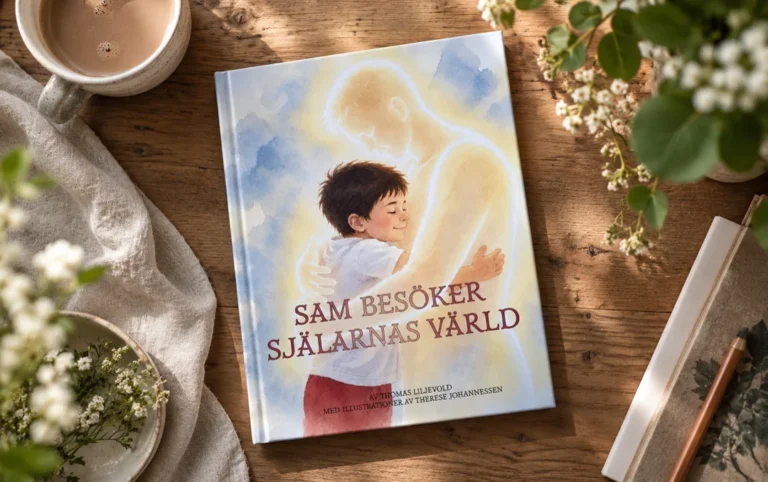

Author Thomas Liljevold did not know that the book he had written felt almost like reading parts of my own childhood. He did not know that I, too, had lost my father as a child, or how deeply it had affected my family in the years that followed. We talked, and somehow, strangely enough, we seemed to understand each other before either of us had really said very much at all. Sam visits the world of souls came to life.
Now, the book is being given new life. It features new and reworked illustrations and will be relaunched in Swedish at the Nordic region’s largest book fair in Gothenburg, from 24 to 27 September.
But the story really begins somewhere else entirely. Because what happens when someone dies in a child’s life?
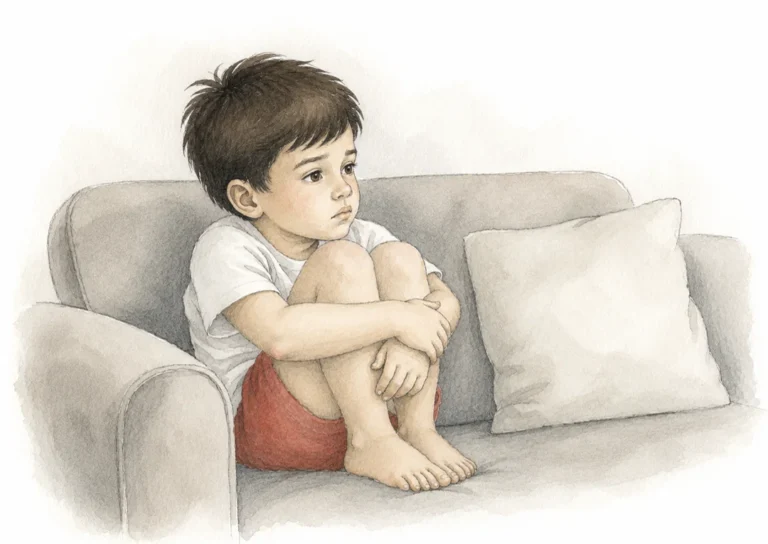
When someone dies, a child loses more than just a person. Suddenly, the world around them can feel different. The adults are grieving too, each in their own way. Some cry, some retreat into silence, while others do their best to keep everyday life moving. And somewhere in the middle of all this is a child, trying to make sense of something that even adults struggle to explain.
I was 8 years old when my father passed away. He was 34.
What I remember from the time that followed is not only the sense of loss, but all the questions that came with it. Where was he now? Could he still see us? Was he somewhere, somehow, or was he simply gone?
And children have their own way of searching for answers.
This is where we meet Sam. He has lost his father, but the story does not end with that loss. One evening, he meets Remiel, who takes him on a journey to Eridanus, the world of souls. There, Sam gets to see his father again and ask some of the questions that can be almost impossible to put into words when you are a child.
The book does not try to explain or prove what happens after we die. Instead, it gives the imagination somewhere to go when reality has no more answers to offer.and that is perhaps why the story resonated with me so immediately.
When Thomas and I first started talking about the book, he did not need to explain how Sam was supposed to feel. I already knew that child, the one left behind trying to make sense of it all. The difference was that Sam got to travel to a place I could only ever imagine.
When someone has to draw the world of souls
There was just one rather significant problem: no one knows what the world of souls looks like.
Thomas had written a story that moves between something deeply familiar and something entirely intangible. Sam is an ordinary child. He sits at home drinking chocolate milk, missing his father and living in a world we recognise. Then, suddenly, he has to leave his body behind and travel somewhere the ordinary rules of our world no longer apply.
My job was to imagine what that place might look like.
No one knows what the world of souls looks like, or whether such a place even exists. That gave us enormous creative freedom, but also a rather impossible place to start. So we drew on familiar symbols and ideas, while allowing the world itself to develop a visual language of its own.
The goal was never to define what life after death might look like. The illustrations were there to give Sam somewhere to go, and to give young readers something visual to hold on to while the story explored much bigger questions.
Because ultimately, the world of souls is not what matters most in this story. What matters is what happens when Sam gets there, who he meets, and the questions he finally gets the chance to ask.
And amid everything fantastical, one thing still had to feel completely real: the bond between a child and the father he misses.
That was the one part I never needed a reference for.
Interested in ordering a copy?
"Sam visits the world of souls" The book is currently available primarily in Sweden, with Norwegian, English and Danish editions coming soon.
Learn more and order hereThen we let the readers have their say
It is one thing to write a book about death. It is something else entirely to place it in the hands of a child and see what comes back.
As part of the Swedish reader panel, children, parents and grandparents all had the chance to read the book. Sam visits the world of soulsThe youngest reader was six, the oldest 78. Their reactions varied, but before long, the same questions began to surface.
Can I go there too? Can dad or grandma still see me? Are they still in pain? Do I have to die to see them again?
And perhaps that is exactly where the book begins to do what it was meant to do.
Six year old Elsa was frightened at first when Sam asked if he had to die to enter the world of souls. Once she understood that he could come back, she felt reassured. But what stayed with her most was the moment Sam saw his father again.
My favourite part was when his dad was healthy again and could hug Sam. It means he isn’t sick there anymore.
Elsa, 6 years old
For ten year old Maja, the story became more personal. It made her think of her grandfather, who had been ill before he died. She did not know if he was in Eridanus, but she hoped he was somewhere he was no longer in pain.
Something else stood out to her as well: Sam is allowed to be angry.
I was angry when grandpa died, even though it wasn’t his fault. I felt a little ashamed of that. After reading this book, I feel like other people can get angry when someone dies too.
Maja, 10 years old
The older children saw the story differently. Thirteen year old Leo was less concerned with whether the world of souls actually exists. To him, the journey could just as easily have been a dream, or something Sam experienced within himself. What mattered was what the journey did for Sam.
The same pattern emerged throughout the reader panel. The younger children tended to step straight into Eridanus and accept it as part of the story. The older readers were more inclined to interpret what they were reading, ask questions, and decide for themselves what they believed.
The adults responded differently again.
De begynte å snakke om sine egne døde.
Foreldre tenkte på hvordan de skulle svare når barna stilte spørsmål. Besteforeldre tenkte på mennesker de selv hadde mistet. Bengt på 71 år tenkte på kona si og på barnebarna som hadde spurt hvor farmor var.
«Jag har sagt att hon finns i våra minnen, men ibland känns det för litet. Hon var mer än ett minne.»
Bengt, 71 år
Det er kanskje en av de fineste beskrivelsene av hvorfor denne boka finnes.
For Sam visits the world of souls trenger ikke å fortelle oss hvor de døde er. Familier tror forskjellig, og noen tror ikke på et liv etter døden i det hele tatt. Det kom også tydelig frem i leserpanelet. Flere ønsket å bruke Eridanus som én mulig forestilling om hva som skjer etter døden, og derfra spørre barnet: Hva tror du?
Det er et spørsmål boka tåler.
Kanskje trenger vi ikke alltid å ha svaret klart før vi begynner å snakke med barn om døden. Kanskje kan vi begynne et annet sted.
Hva tror du?