

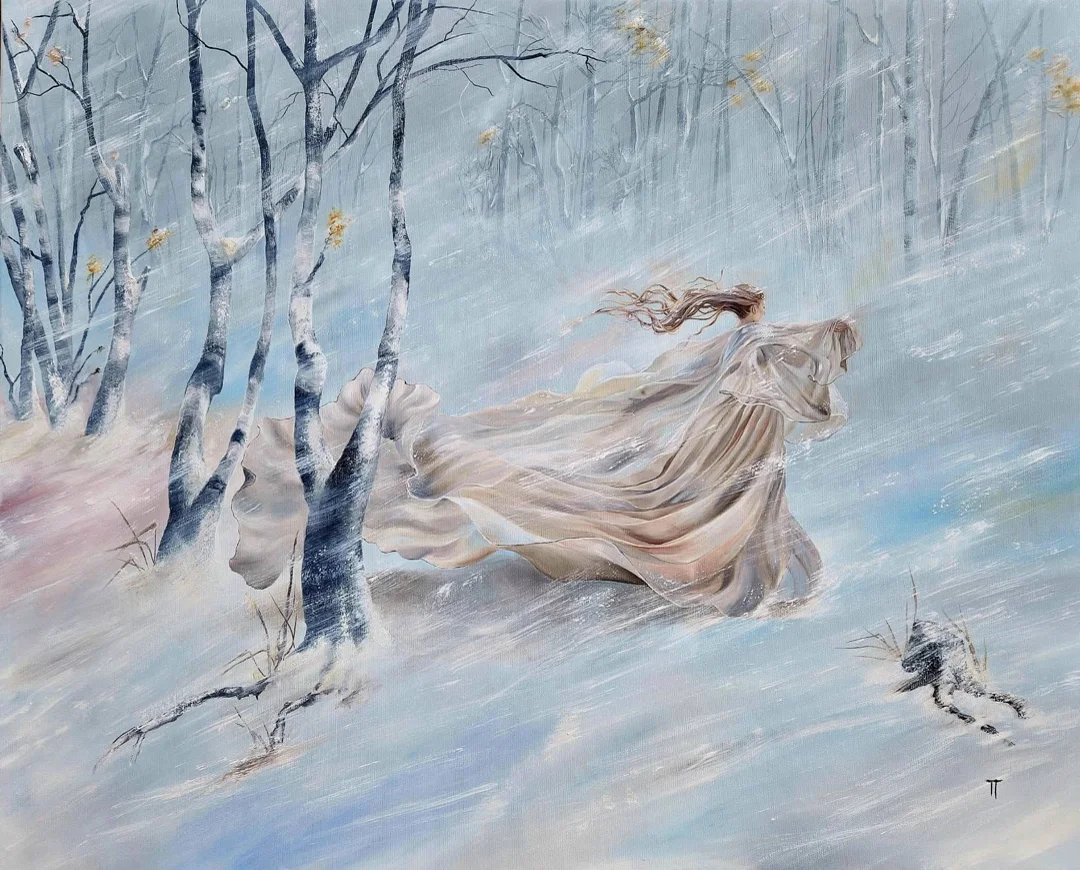
The Snow Queen is inspired by Hans Christian Andersen's timeless tale of Kay and Gerda, this work draws on a story of love, longing, and the eternal struggle between warmth and cold. In the fairy tale, the Snow Queen is both beautiful and unattainable, a figure who lures Kay into a kingdom of ice where his emotions gradually freeze into silence. Yet she is far more than an antagonist; she embodies the forces of nature itself, the face of winter and the unyielding stillness that settles over the world when it is blanketed in snow.
In this work, the Snow Queen is not portrayed as a monarch crowned with symbols of power. Instead, she is part of the landscape itself, born of the wind, the snow, and the frost. Her form dissolves into her surroundings, as though she could just as easily be a drifting snowbank or a passing gust of icy wind. She belongs to nature far more than she belongs to humanity.
The flowing gown breaks with the painting's realism, existing somewhere between fabric, ice, and mist. It drifts effortlessly through the landscape, as though untouched by gravity. Its movement brings a sense of stillness that nevertheless feels alive, a reminder that even the most frozen world is never truly motionless.
The work explores the contrast between beauty and untouchability. The Snow Queen becomes more than a fairy-tale figure; she is the embodiment of winter itself, beautiful, timeless, and boundless, where humanity and nature merge into a single, unified presence.