

Artess has a new look, but the biggest change actually started with me. After many years of realism, intricate detail, illustration and quite a few creative detours, I’ve begun to see a clearer direction in my art. Now, it’s finally getting more room to grow.
I’ve never been particularly good at choosing just one thing.
Over the years, I’ve worked with hyperrealism, portraiture, pencil, charcoal, painting, illustration, books, design and quite a few projects that probably started with me thinking, “I could probably learn how to do that.” It has also pulled me into marketing, digital design, business development, web design and a whole host of other projects.
It might sound a little all over the place.
But when I recently started going through old works, sketches and projects, I realised there was a much clearer thread running through it all than I’d been aware of. The craftsmanship has always been there. The fascination with detail, precision, and just how far a technique can be pushed.
But the stories wanted to be told.
Mythology, folklore, symbolism and, increasingly, my own Sámi and Nordic cultural heritage have surfaced again and again. The difference is that I no longer want to treat them as interesting side projects.
I want to see how far I can take it.
And that’s really why Artess looks different. The website hasn’t taken a new direction. It’s simply had to catch up with mine.
The craftsmanship has always been there.
I have a somewhat strained relationship with “good enough”.
If something looks almost right, I usually notice what’s wrong with it first. A transition that’s too harsh. An expression that’s slightly off. Light that isn’t behaving as it should. Or hair number 4,783, which has clearly decided to go in the wrong direction.
That’s probably one of the reasons realism became such a big part of my art.
Not because the goal has always been to replicate reality as perfectly as possible, but because the technique pushes back. Reality is ironically imperfect. It demands observation, precision and patience, and there is almost always another level to strive for.
Over the years, this has led to hyperrealistic portraits, animals, large-scale pencil works, paintings, illustrations and commissions far beyond Norway. The materials have varied considerably. The urge to find out “How far can this be pushed?” has remained considerably more consistent.
It’s still an important part of my art.
But over time, another question has become more interesting than how well can I make this?
What do I actually want to use it for?
When the stories take up more space
Technique can keep me occupied for a very long time. But at some point, it’s not enough for something to be difficult to make. It has to be interesting to make, too.
Mythology and folklore have been finding their way into my work for a long time. Now, my Sámi cultural heritage in particular is taking up more space. It’s part of my own family history, but it wasn’t an obvious part of what I grew up with. Wearing Sámi shoes as a child doesn’t necessarily mean you grow up with Sámi culture as part of your identity. In fact, it can make that connection feel even more fragmented. But perhaps that makes it all the more interesting to explore?
Not as historical depictions of a world that once was, but as stories that can continue to evolve.
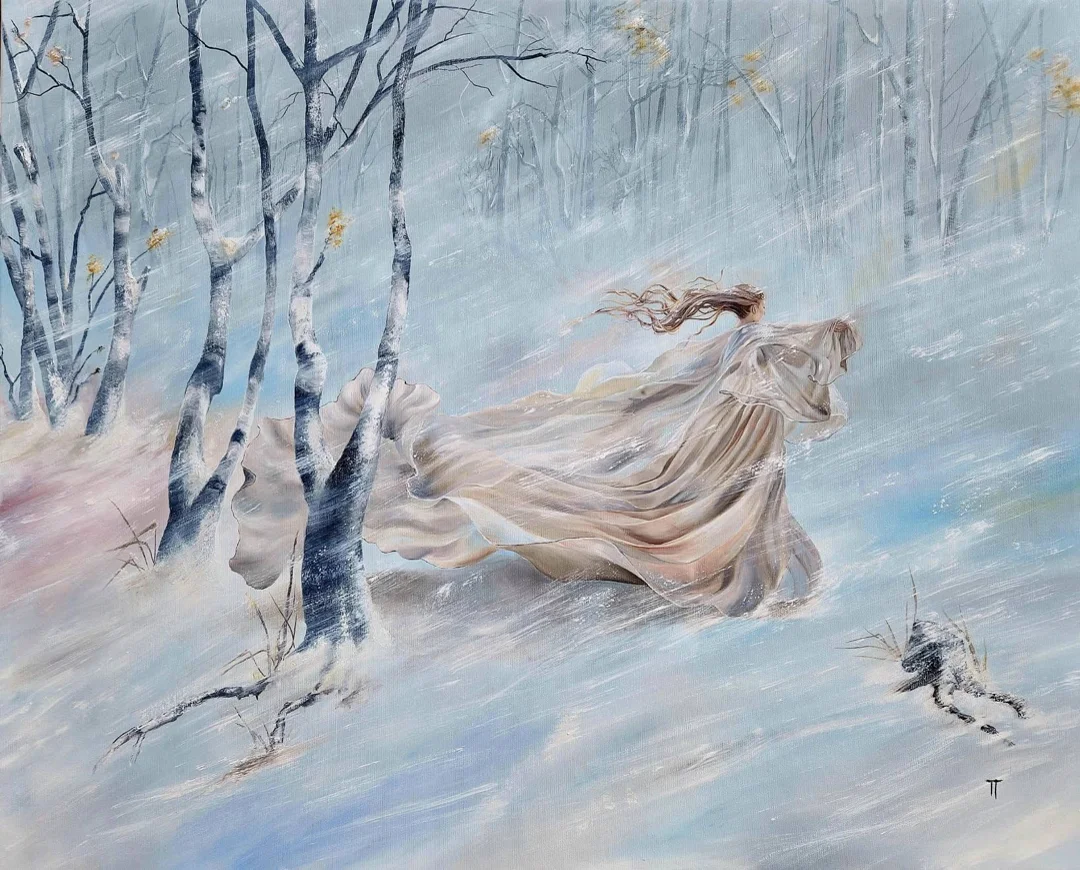
Where is Stállo, the strong but slightly dim-witted giant, in 2026? What does a noaide look like without becoming a generic “shaman”? What happens when old beliefs are given a modern visual language?
Some of the first attempts are simply 6.4 × 8.9 centimetres in size.
A whole universe in 6.4 × 8.9 cm
It turns out that big stories don’t need much paper.
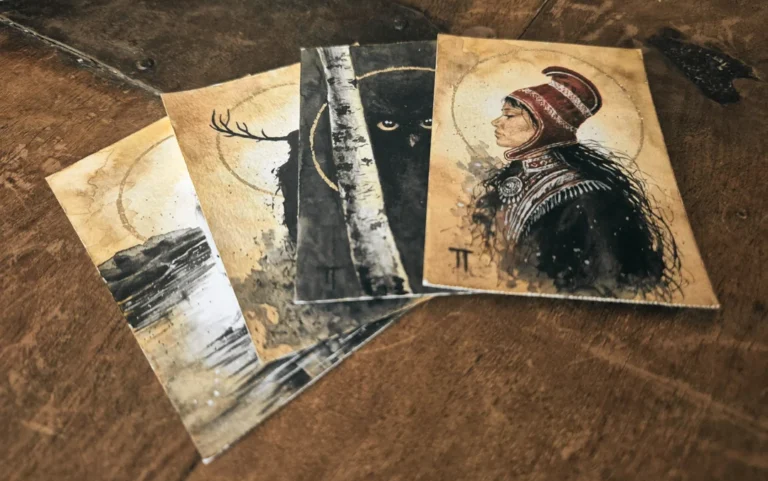
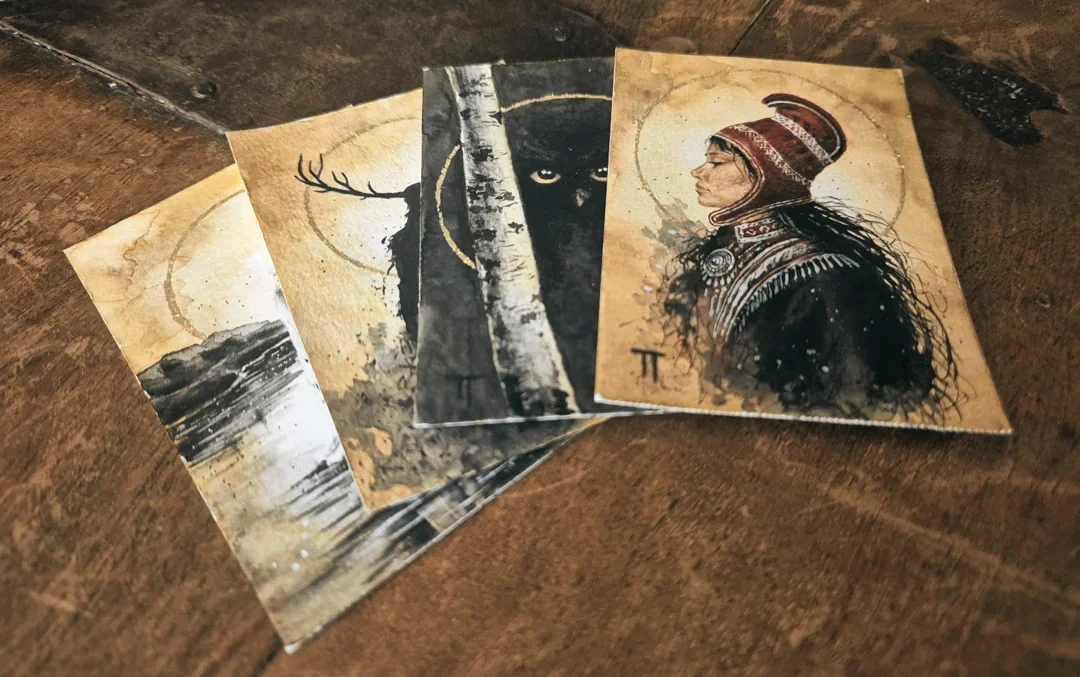
ACEOs are original works of art the size of a classic trading card. The first series from Artess draws on Sámi mythology, with each card giving a single figure or belief centre stage. Think Pokémon or football trading cards.
The noaidi. Stállo. Ulda. Sáráhkká. Máttaráhkká. Ten motifs in the first series, all drawn by hand and all one of a kind.
The small format forces me to approach things differently from my larger, highly detailed works. Fewer elements. A clearer expression. Still enough detail for me to make life difficult for myself.
And this is only the first series.
From the finished work to everything that happens before it
A finished work only tells part of the story. That’s why more of what happens before before the signature ends up on the paper will be given more space.
In From the studio there will be processes, sketches, research, techniques and projects while they’re still works in progress. Including the wrong turns, because they have an annoying tendency to be rather educational.
The idea is to make it possible to discover both how a work comes to life and what lies behind the subject. A little less “here’s the finished piece”, and a little more “let’s see what happens if we try this”.
The larger works aren’t going anywhere.
A new direction doesn’t mean the hyperrealism, portraits and large-scale detailed works are going anywhere.
They’re still an important part of my art. The difference is that technique no longer needs to be the whole point.
Some works will still be about observation, light, expression and how far realism can be pushed. Others can use the same craftsmanship to give form to something that has never stood in front of a camera.
One doesn’t have to replace the other.
It just gives me more things to make.
Art that can actually come home with you
It’s nice to look at art on a screen. But that’s not where it’s meant to end up. That’s why available works will have a more prominent place on Artess. Originals first, followed by art prints, ACEO cards and books.
Not everything will arrive at once. Things get to be finished before they’re launched. A surprisingly radical idea on the internet.
The goal isn’t to build a huge online shop, either. It’s simply to make it easier to find the art that’s available, and perhaps discover something you might actually want to live with.
Artess just had to keep up.
All of this actually started with a new website. It ended up becoming a fairly thorough look at what I make, what I want to make more of, and what I want Artess to be used for going forward.
Fortunately, the conclusion isn’t a five-year plan.
There will be more art. More craftsmanship. More stories to dig into, more experiments, and probably a few ideas that turn out to be considerably better in my head than on paper.
Artess is still just the place where it all comes together.
The interesting part is what happens next.
Will I be in Mongolia in a couple of years? I’ve been asked. I’ll tell you more about that too…